
Ammonite

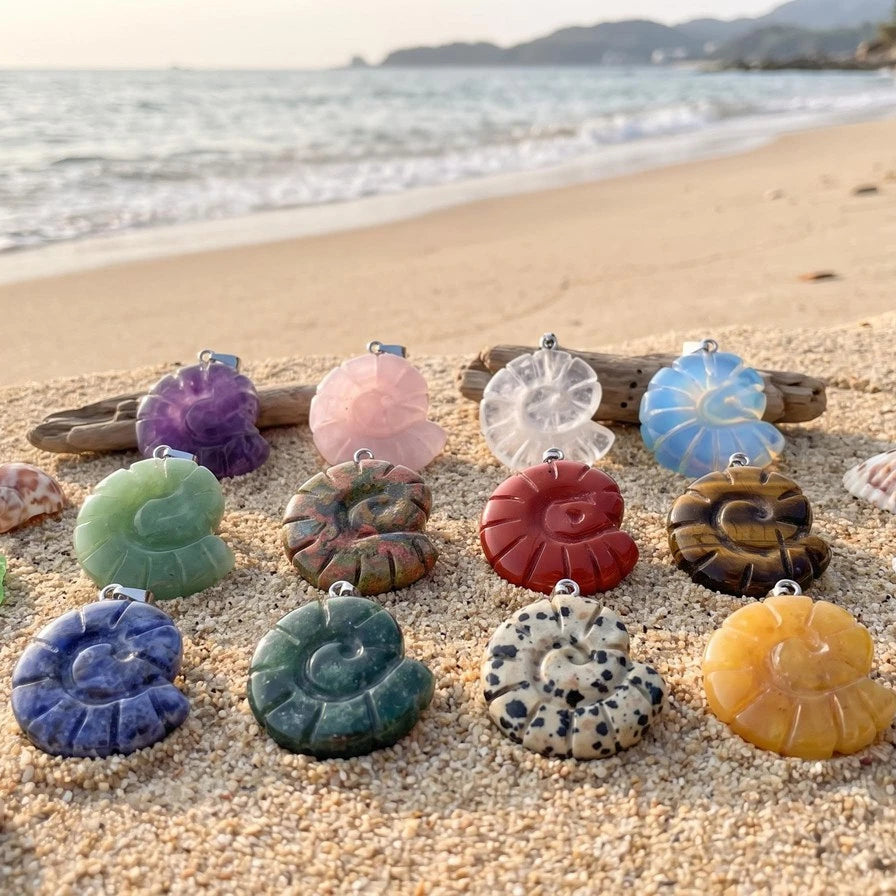

Ammonite: Meanings and Properties
Ammonites are not crystals or minerals in the traditional sense, but rather the fossilized remains of ancient marine creatures. These extinct mollusks, related to the modern nautilus, squid, and octopus, lived in the seas during the Jurassic and Cretaceous periods, approximately 201 to 66 million years ago . Their name is derived from the Egyptian god Ammon, who was often depicted with ram's horns, resembling the spiral shape of the fossil .
When the ammonite shell fossilizes with a vivid, iridescent play of color, it is known as Ammolite, a rare and valuable gemstone found primarily in Canada . Ammonite's core meanings are deeply connected to its ancient origins and spiral form, revolving around stability, change, energy flow, and prosperity.
Core Meanings and Symbolism
1. Grounding, Stability, and the Root Chakra
As ancient relics of the Earth, ammonites carry a powerful grounding energy. They connect us to the deep, stabilizing forces of the planet and the passage of geological time .
-
Meaning: It symbolizes a strong foundation and a connection to the Earth. Ammonite is strongly associated with the Root Chakra, promoting feelings of security, stability, and a sense of belonging in the physical world .
2. Positive Change, Motion, and Evolution
The spiral shape of the ammonite is a powerful symbol of continual change and evolution . It represents the natural cycles of life, death, and rebirth.
-
Meaning: It symbolizes progress and the forward motion of life. The spiral is seen as drawing in negative energy, filtering it through its chambers, and releasing fresh, positive energy . It helps one to adapt to change and embrace personal evolution.
3. Ancient Knowledge and Wisdom
Having existed on Earth for hundreds of millions of years, ammonites are considered keepers of ancient, primordial knowledge .
-
Meaning: It symbolizes access to deep wisdom and understanding of life's cycles. It is believed to help unlock past-life memories and connect with the accumulated knowledge of the Earth itself . It encourages patience and a long-term perspective.
4. Energy Flow, Structure, and the Fibonacci Spiral
The logarithmic spiral of the ammonite's shell is a perfect example of the Fibonacci sequence, a mathematical pattern found throughout nature, from galaxies to DNA .
-
Meaning: It symbolizes perfect order, harmony, and the flow of universal energy. It is thought to help structure and organize chaotic energy, bringing balance to one's environment and life. In Feng Shui, its spiral shape represents the cosmic energy that enhances health, wealth, and enlightenment .
5. Prosperity, Abundance, and Protection
In many cultures, particularly in parts of Asia, ammonite fossils are revered as powerful attractors of good fortune .
-
Meaning: It symbolizes wealth, success, and a protective shield. Its spiral shape is believed to "curl inwards," drawing in and holding onto wealth, with "no way out" . It has also been used historically as a charm to ward off negative energy and bring harmony to a dwelling .
Ammonite and the Chakras
Ammonite's energy is complex and can be used to work with multiple chakras.
-
Root Chakra (Muladhara): This is its primary association. Ammonite grounds spiritual energy into the physical plane, providing a stable foundation for all other healing work .
-
All Chakras (via Ammolite): When an ammonite fossil displays the full spectrum of iridescent colors (becoming Ammolite), it is believed to resonate with and balance all seven chakras . The vibrant reds, oranges, yellows, greens, blues, indigos, and violets correspond to the energy centers from the root to the crown .
History, Folklore, and Fascinating Facts
-
Snakestones: In medieval England, ammonites were commonly known as "snakestones." A popular legend, particularly in Whitby, Yorkshire, told that these were snakes that had been turned to stone by the Abbess St. Hilda. Carving a snake's head onto the fossil was a common practice to "complete" the legend . They were used as charms for protection against serpents, as well as for curing baldness and infertility .
-
The God Ammon: The scientific name "Ammonite" was inspired by the ram's horn-like shape of the shell, which resembled the horns depicted on the head of the ancient Egyptian god Amun (Ammon) .
-
Extinction: Ammonites went extinct at the end of the Cretaceous period, approximately 66 million years ago, during the same mass extinction event that wiped out the dinosaurs .
-
Index Fossils: Because they evolved rapidly and had a wide geographical distribution, ammonites are considered exceptional index fossils. Geologists use them to identify and date the specific time periods of the rock layers in which they are found .
-
Gem-Quality Ammolite: The iridescent gemstone Ammolite is one of the few biogenic gemstones (along with amber and pearl). It is found in commercial quantities almost exclusively in the Bearpaw Formation of Southern Alberta, Canada, and was officially recognized as a gemstone by the World Jewellery Confederation (CIBJO) in 1981 .
In short, Ammonite is a profound symbol of Earth's ancient history, grounding energy, and the cyclical nature of life. Its spiral form represents the continuous flow of energy, positive change, and the structuring of chaos. It offers stability, attracts prosperity, and connects us to the deep, slow wisdom of the planet.
Ammonite: An Introduction (Concise)
Ammonite is not a stone, but the fossilized shell of an ancient marine mollusk that lived millions of years ago during the Jurassic and Cretaceous periods . Its name comes from the Egyptian god Ammon, who was depicted with ram's horns resembling the fossil's spiral shape . When this fossil displays a vivid, iridescent play of color, it is known as Ammolite, a rare gemstone .
Known as the "Stone of Stability and Change," Ammonite is prized for its grounding energy and its powerful connection to the Root Chakra, promoting feelings of security and foundation . Its iconic spiral symbolizes positive motion, evolution, and the orderly flow of universal energy, often drawing in negativity and releasing positivity . In Feng Shui, this spiral is believed to attract wealth and prosperity, with energy curling inward and holding tight .
As ancient fossils, they are also considered keepers of profound, ancient wisdom, helping to connect us with the deep history of the Earth . Found on every continent, they are revered in many cultures—from medieval European "snakestones" used for protection to modern Asian traditions where they are placed to enhance fortune and harmony . Ammonite is a powerful tool for grounding, navigating change, and attracting abundance.